The old town of Trebinje — Stari Grad, or Kastel, as locals call it — is small enough to walk in one breath and old enough that every door opens onto four centuries. It is not a museum. People live here — sleep here, argue here, dry washing in the courtyards — and that living is what saves it from being merely pretty.
Built in the early 1700s as an Ottoman fortress on the right bank of the Trebišnjica, above the river’s deepest point — a place called Ban-vir, after the local legend of a ruler who drowned in its vortex — Kastel was raised by Osman Pasha of the Resulbegović family, with stonemasons brought up from Dubrovnik. The walls that survive today — the towers, the ramparts, the clock tower still keeping time — reached their final form in the first decades of the 18th century. It is one of the best-preserved Ottoman strongholds in Herzegovina, and you can cross it end to end in twenty minutes. Start at the square and let the town tell you the rest — the official tourism guide to Kastel gives you the fuller history if you want it.
Trg slobode
Start at the square, which is less a plaza than a wide stone room with trees. On one side the old town begins; on the other, the newer town. The plane trees are the real monument — locals will tell you the square is simply “under the platanima.” There are sixteen of them, planted in 1895 by the city’s Austro-Hungarian commander in memory of his daughter, and they have grown into the city’s symbol. Look up from the coffee and you will also find the Monument to the Liberators, whose angel on a five-metre column was a gift from Trebinje’s most famous son, the poet Jovan Dučić.
The alleys behind the square
Leave the square uphill, toward the old walls. The streets narrow, the balconies lean closer together, and the stone turns that particular honey colour the local sandstone achieves at four in the afternoon. Keep an eye out as you go — the landmarks below hide in plain sight, and each of them has a section further on:
- The canal gate — the low tunnel entrance where the drawbridge once hung.
- The clock tower — the Sahat-kula, still ticking from the Ottoman era.
- The mosques — Sultan Ahmed’s and Osman Pasha’s, which anchor the old town’s skyline.
- The house with the grapevine — a vine older than the republic that once owned it.
- The staircase to nowhere — a flight of steps that ends at a wall and a view, which is reason enough.
The canal gate
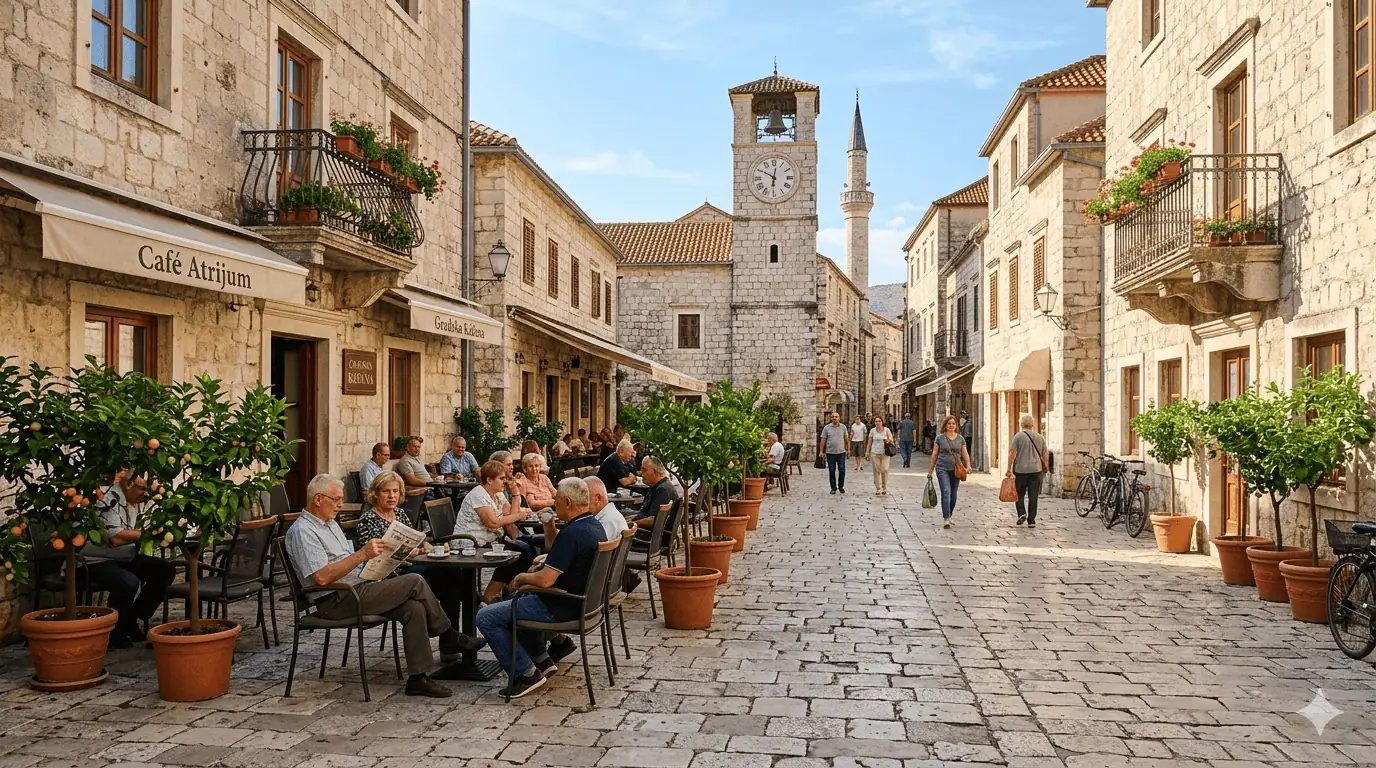
The old town’s main entrance is a low stone tunnel that feels more like a cave than a gateway — until someone tells you what it used to be. When Kastel was a working fortress, a defensive canal (hendek) was dug around the whole of it and fed from the Trebišnjica, and this entrance had a drawbridge that had to be raised against visitors of the wrong kind. The tunnel is all that remains of that arrangement. In 1932, on the advice of a physician worried about epidemic disease in stagnant water, the canal was filled in and levelled, and the drawbridge went with it. Walk through slowly, and you are passing through the town’s front door as it stood for two hundred years.
The clock tower
Just inside the walls, the Sahat-kula — the clock tower — still does the job it was built for under Ottoman rule. Clock towers like this one were the civic heartbeat of Balkan towns under the empire, marking the hours of prayer and of the market, and Trebinje’s has somehow kept ticking through every regime since. It is not tall by modern standards, but it is the old town’s one reliable vertical landmark: when the alleys all start to look alike, the tower is the compass that tells you which way the walls are.
The mosques
Two Ottoman mosques anchor the old town, and together they tell Kastel’s strangest story.
The older is the Sultan Ahmed Mosque — the Careva džamija, or Emperor’s Mosque — built in 1719 by Osman Pasha Resulbegović in the name of Sultan Ahmed III. According to the Dubrovnik archives, it was raised by craftsmen from the Republic with finely cut stone and a distinctive four-sided brick-tile roof, and it stands near the river bank, close to the old town’s edge.
Seven years later, Osman Pasha built a second mosque in his own name. The Osman Pasha Mosque went up in 1726 beside the main western gate, built by the same Dubrovnik masters with a four-pitched roof in imitation of a dome and a 16-metre octagonal stone minaret that was counted among the most beautiful in Herzegovina. It became known as the most spacious mosque in the region, and Osman Pasha added a maktab and a madrasa beside it — the first schools Trebinje ever had.
Then the story turns. In Istanbul, the sultan heard that his governor had built a mosque more beautiful than the emperor’s own — and in his own name. Ahmed III condemned Osman Pasha and his nine sons to death. Osman Pasha travelled to Constantinople to plead for mercy, was refused, and was executed in 1729.
The two mosques still stand a short walk apart, one in the emperor’s name and one in the governor’s — an argument in stone about who got the better of it, still running three centuries later.
The bridges
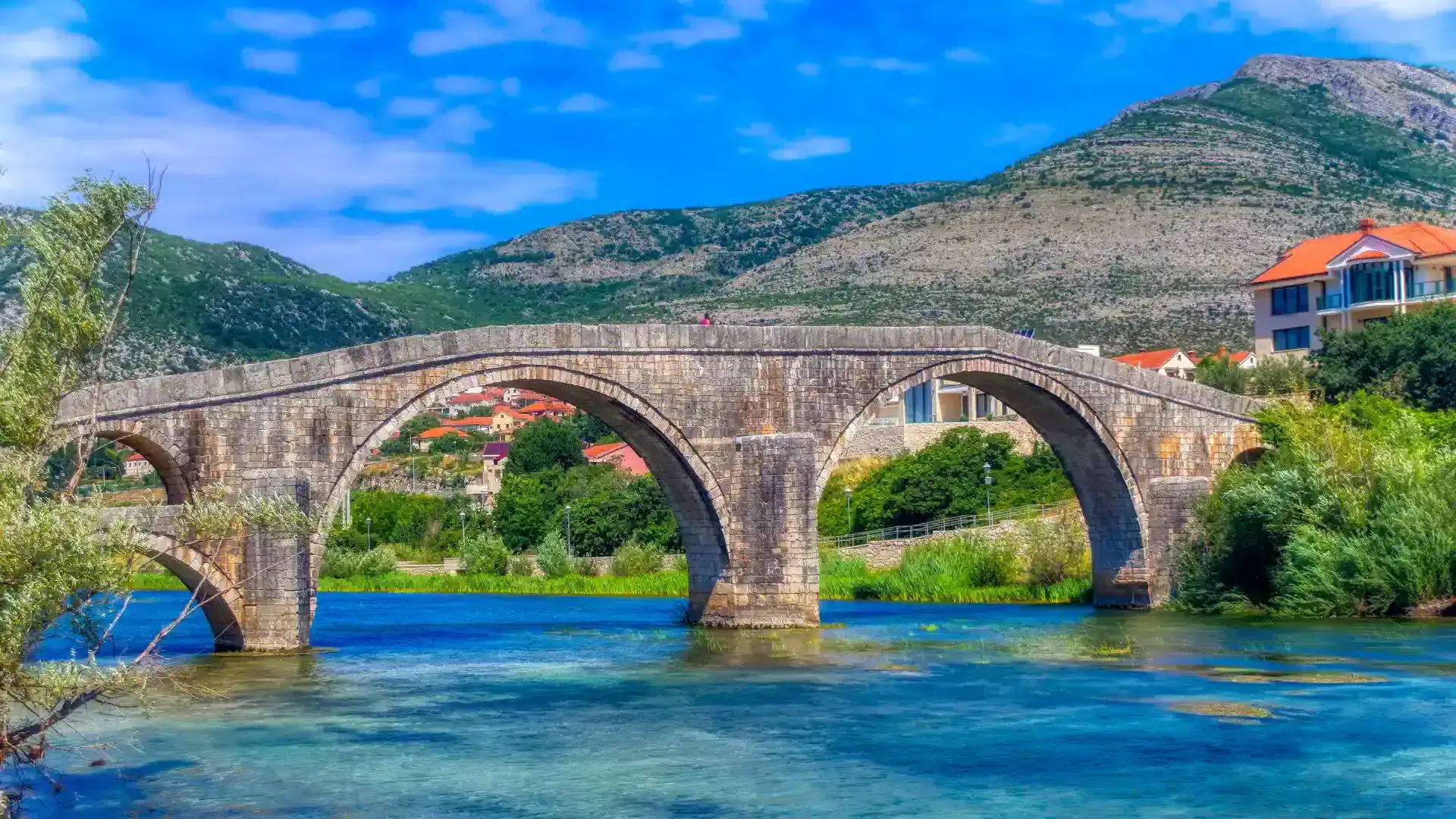
The old town ends at the river, and the river is the second half of the walk. Follow the bank south and you will reach the Arslanagića Bridge — the oldest bridge in Trebinje and one of the most important monuments in Herzegovina. Built in the 16th century during Ottoman rule, its nine stone arches (the two central ones dramatically larger) span 92 metres of the Trebišnjica, and its flat, broad deck was built to carry more than foot traffic — mules, carts, and the tolls they paid. When the river was dammed in 1966, the bridge was carefully dismantled stone by stone and rebuilt downstream, between the Gradina and Police neighbourhoods, where it still carries daily foot and vehicle traffic. Ask around and you will hear it called by both its names — the historic Arslanagića and the more recent Perovića.
A neighbourhood, not a stage
What keeps Stari Grad alive is its ordinariness. Schoolchildren cut through it. An old man repairs a shutter. The café on the corner is where pensioners hold court until lunch. Respect it as you would any residential street: no loud groups at seven in the morning, no climbing on the Ottoman stones.
Tourists photograph my door. It’s a nice door. Everyone agrees.
The view
At the top of the old town, by the fragment of the wall, the town opens below you: red roofs, the green ribbon of the river, the hills folding away toward Montenegro. Stand there at sunset and you will understand the neighbourhood’s one ambition — to keep doing exactly this, for another four hundred years.
From there, the rest of Trebinje is twenty minutes in any direction on foot — the getting around guide covers how the old town fits into the wider city. If it is your first morning, our first-morning walk takes you through the old town and on to the river terraces, where a coffee and a long pause wait.