On this page
- Housing: Where Your Money Actually Goes
- Short stays (1–3 months, Airbnb-style)
- Monthly lets, direct (3 months +)
- What the indexes say
- Monthly utilities
- Connectivity: The Remote Worker’s Real Requirement
- Food and Groceries: Fresh, Cheap, and Repeatable
- Supermarkets
- The market: your unfair advantage
- Eating out
- Healthcare: Insurance for the Not-Yet-Resident
- Getting Around: Cheap by Default
- Sample Monthly Budgets: What Does It Add Up To?
- Lean Month (outskirts flat, direct landlord, mostly cooking)
- Comfortable Month (the standard remote-worker scenario)
- The Frugal-Stay Version (platform-booked, 1–2 months)
- How It Compares
- Money-Saving Tips for Remote Workers
- Hidden Costs to Budget For
- The Bottom Line
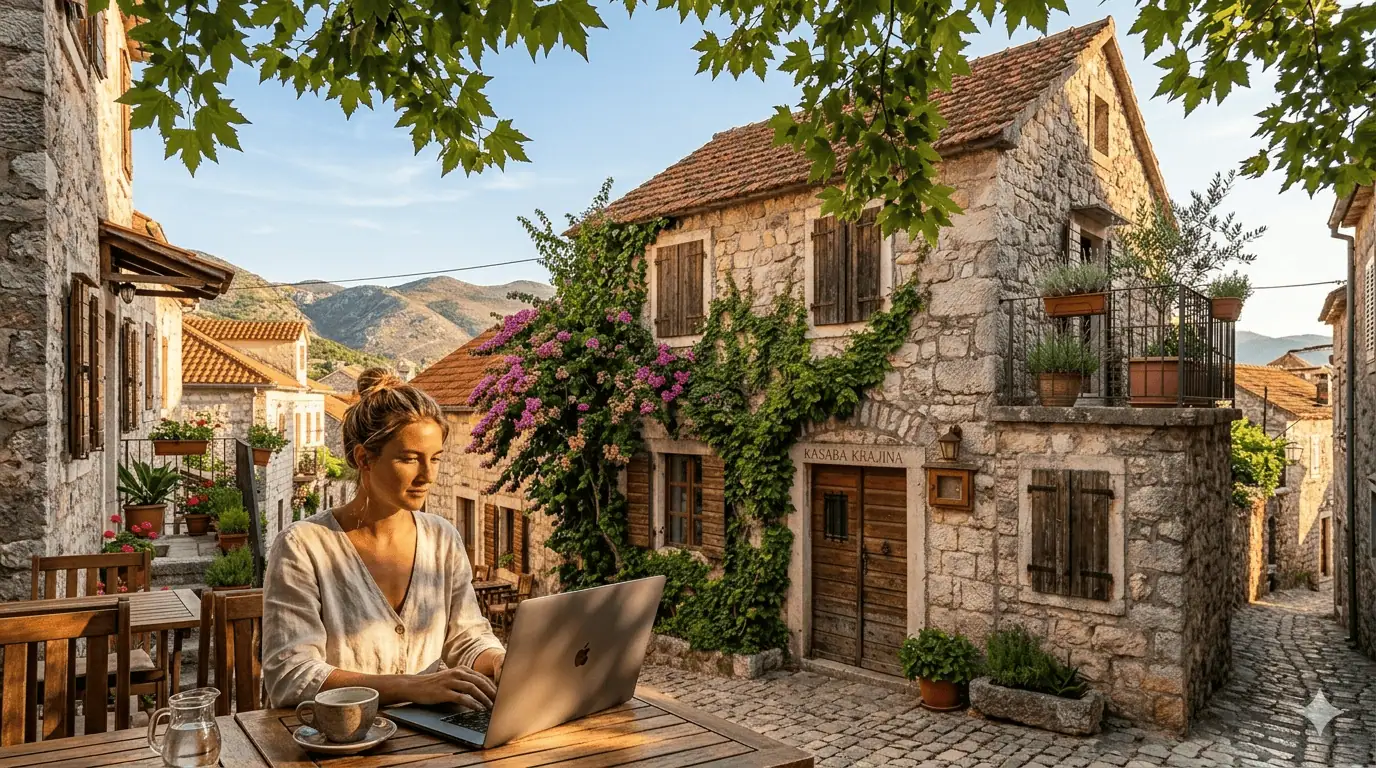
Imagine clocking off at five, walking two minutes to the river, and ordering a coffee for €1 while the light goes amber over the old town’s walls. That is a normal Tuesday for a remote worker in Trebinje — and the whole arrangement costs less than your current rent alone in most Western cities.
Trebinje, Bosnia and Herzegovina’s southernmost city, sits twenty minutes from the Dubrovnik border, surrounded by vineyards and the green Trebišnjica river. It has fast fiber internet, a relaxed pace, and a cost of living that keeps a comfortable remote-work month under €1,000. It is not “Southeast Asia cheap” — it is “Western European quality of life at Eastern European prices” cheap, which is the part that surprises everyone.
Whether you are scouting it as a digital nomad base, comparing it to the retirement picture, or just running the numbers before a longer stay, this breakdown gives you the real, current costs of working from Trebinje — the ones third-party price indexes and your gut disagree about.
Housing: Where Your Money Actually Goes
Rent is the biggest line in any remote worker’s budget, and it is also the line where Trebinje differs most from what you might be used to. The key rule: how you rent matters more than where.
Short stays (1–3 months, Airbnb-style)
Booking through platforms is the most expensive way to live here — expect €400–€700 for a furnished month in the centre, depending on season. July and August are the peak; a winter let on a platform can quietly drop 30–40%. It is not a bad way to test the water, but you are paying the platform premium.
Monthly lets, direct (3 months +)
Once you commit to staying, the prices change category. A furnished one-bedroom in the centre rents for €250–€400, less in the residential neighbourhoods a ten-minute walk out. The Police and Bregovi areas have the best stock of modern, quiet apartments — the digital nomad guide covers the neighbourhoods in detail. Locals rent by word of mouth, so the standard move is simple: book a month on a platform, then walk the streets and talk to landlords. The moment they see you are staying, the price drops and the apartment gets honest.
What the indexes say
Independent price trackers cluster around the same numbers. Numbeo puts a city-centre one-bedroom at roughly €255, and Wise’s cost data lands in the same range — with the clear caveat that platform-booked short stays run well above both. The gap between “tourist price” and “local price” is the single biggest lever in your budget.
Monthly utilities
- Electricity, water, garbage: €40–€80 (higher in winter if you use electric heating)
- Fiber internet (unlimited, 60–100 Mbps): €20–€30
- Mobile plan (10 GB+): €10–€20
For a one-bedroom you should budget €60–€90 a month for utilities and internet combined, which matches what locals actually report. Heating in winter pushes it up; the cheap hack is a wood stove if your place has one.
Connectivity: The Remote Worker’s Real Requirement
For most people this is not a budget category at all — it is a deal-breaker check. Trebinje passes it comfortably. Fiber is available across most of the centre, delivered by m:tel and Telemach, and 50–100 Mbps is routine, even in peak evening hours. Upload holds up for video calls, which is the test that matters.
Test the apartment, not the listing. Download speeds are usually quoted honestly; upload is where old buildings betray you. And bring your own router if you care about reliability — the stock one in a furnished flat is often the weak link.
Mobile coverage is solid. A tourist SIM with roughly 20 GB costs about 15 BAM (under €8) and doubles as a backup hotspot; for a longer stay, a postpaid plan with 10 GB+ runs €10–€20 a month. A regional eSIM covering Bosnia, Croatia and Montenegro is worth a few extra euros once the day-trip season starts.
Food and Groceries: Fresh, Cheap, and Repeatable
Supermarkets
Trebinje has modern supermarkets (Mercator, Interex, Tuš) with prices well below Western Europe:
- Bread (fresh, local): €0.50–€0.80
- Milk (1 litre): €0.80–€1.00
- Eggs (10): €1.50–€2.00
- Chicken breast (1 kg): €4.00–€5.50
- Local cheese (1 kg): €5.00–€7.00
- Tomatoes (1 kg): €1.00–€2.00 in season
- Wine (decent local bottle): €3.00–€6.00
A remote worker who cooks lands around €150–€250 a month on groceries — less if you lean on the market.
The market: your unfair advantage
The green market on the square is where the smart shopper wins. Seasonal produce from the farms around town is dramatically cheaper and better than supermarket stock, and the markets and producers guide explains what to buy and when. Summer tomatoes for pocket change, fresh figs in August, honey from the hills behind town.
Eating out
This is where remote workers — who eat outside the flat more than most — need to be honest with themselves. Prices are low, which makes it easy to over-eat out:
- Coffee at a terrace: €1.00–€1.50
- Tavern lunch (the real local tables): €8.00–€12.00
- Beer (0.5 L): €1.50–€2.50
- Glass of local wine: €1.50–€3.00
- Budget dinner: €5.00–€8.00
- Mid-range dinner with wine: €12.00–€20.00
A working lunch out most weekdays plus a couple of dinners lands around €200–€300 a month. If you want it lower, the answer is the market and the oven, not better budgeting apps.
Healthcare: Insurance for the Not-Yet-Resident
This is where remote workers differ from retirees. For stays under 90 days you are not in the local public system — you rely on travel or private health insurance. The expat insurance guide breaks down when travel insurance is enough and when you need a proper international plan:
- Travel/private health insurance (SafetyWing-style, nomad policies): €40–€80 a month
- Private GP consultation: €20–€40
- Private specialist: €40–€70
- Basic blood work: €20–€40
- Dental cleaning: €30–€50
Private clinics are good and cheap enough that many long-stayers simply pay out of pocket for routine care and keep insurance for the big stuff. Pharmacies are well stocked, and many common medications that need a prescription at home are available over the counter here. A cross-border bonus: Croatia (EU) is thirty minutes away if you ever need an EU-priced pharmacy run.
Getting Around: Cheap by Default
Trebinje is walkable end to end — most remote workers will not touch a vehicle all week. When they do:
- Local bus: €0.80–€1.00
- Taxi across town: €3.00–€6.00
- Bus to Dubrovnik: ~€15
- Bus to Mostar: ~€12
- Bus to Kotor (Montenegro): ~€18
- Car rental for a weekend: €40–€70 a day
The position is the real asset: the Adriatic, a second country’s old town, and the Bay of Kotor are all weekend trips, not logistics projects. The getting around guide has the timetables and the border-crowding wisdom.
Sample Monthly Budgets: What Does It Add Up To?
Lean Month (outskirts flat, direct landlord, mostly cooking)
- Rent (furnished one-bedroom, outside centre): €200
- Utilities + internet: €70
- Groceries (market-heavy): €150
- Eating out (a few coffees + 4–6 meals): €80
- Mobile + SIM: €15
- Coworking (a couple of days a week) or café budget: €40
- Insurance: €50
- Transport + leisure: €50
Total: ~€655 per month
Comfortable Month (the standard remote-worker scenario)
- Rent (furnished one-bedroom, centre): €300
- Utilities + internet: €85
- Groceries: €200
- Eating out (lunches + dinners, the good tables): €250
- Coworking membership: €75
- Mobile: €15
- Insurance: €60
- Transport + weekend day trips: €80
- Gym + leisure: €50
- Miscellaneous: €50
Total: ~€1,165 — realistically €1,000–€1,200 for the “comfortable” month
The Frugal-Stay Version (platform-booked, 1–2 months)
If you book through Airbnb and mostly eat out for a month, the same life costs €1,200–€1,500 — which is exactly why the local rule exists: the longer you commit to staying, the cheaper Trebinje gets. This is the “nomad tax” you will hear about everywhere in the Balkans; Trebinje just has a lower base price to start from.
The short version: budget €700–€900 a month for a genuinely comfortable long-stay life, or €1,000–€1,200 if you arrive short-term and rent through platforms.
How It Compares
- vs. Lisbon or Barcelona: you will spend 50–60% less on the same lifestyle, and the internet is comparable.
- vs. Medellín or Chiang Mai: Trebinje is pricier than the classic cheap hubs — but it is in Europe, next to the Adriatic, with fiber and four seasons.
- vs. Split or Budva (the Adriatic alternatives): Trebinje costs roughly 40–60% less for rent and food, with the sea forty minutes away instead of on your doorstep.
- vs. Belgrade: broadly similar totals, with more sunshine and none of the capital’s busyness.
- vs. Mostar: the main regional alternative, roughly 10–15% pricier and busier — the full Trebinje vs. Mostar comparison covers both from the ground up.
Money-Saving Tips for Remote Workers
Rent direct, negotiate, and time the season: the single biggest saving on the whole list. Winter is negotiation season — landlords discount hard when the city is quiet.
Do the coworking maths properly: if you work outside the flat a few days a week, a €50–€100 membership beats daily café coffees, and the cafés worth using for work are a known list, not a mystery.
Shop the market, not just the supermarket: the producer’s guide is worth reading before your first Saturday.
Eat local: tavern lunches at €8–€12 beat imported everything, and the wine country weekend loop turns a tasting into a cheap day out.
Carry a fee-free card and keep cash: Bosnia runs on the convertible mark (BAM), pegged to the euro at 1.95583. Cards work in supermarkets and nicer places, but the small cafés and the market want banknotes — and most daily life here is small enough that ATM fees would quietly eat your month.
Use the 90-day geography: Bosnia is not in Schengen, so your 90 visa-free days do not count against your Schengen allowance — a genuinely clever rotation trick for the remote worker hopping through Europe. Details and the residence route are in the nomad visa section.
Hidden Costs to Budget For
- Visa/residence: 90 days are free for most Western passports; a temporary residence permit for longer stays runs roughly €50–€100 in fees, plus paperwork.
- Banking/transfers: bank wire fees can be €15–€40 per transfer. Wise or Revolut are the standard workaround for foreign income; see opening a local account for the non-resident vs resident setup.
- Flights: the nearest international airport is Dubrovnik, 30 minutes away — a weekend flight home is cheap, but summer prices spike. Budget €100–€250 for a return within Europe.
- Gear: bring your laptop, a backup drive and a good router. Trebinje is safe and calm, but it is not an electronics supermarket — replacing a laptop here means a trip to Dubrovnik or a delivery wait.
- Customs: receiving packages from outside Bosnia can trigger duties and VAT (17%).
- Winter heating: if your flat runs on electric heating, December–February utilities can nearly double. Check the heating method before you sign.
The Bottom Line
A remote worker can live genuinely well in Trebinje on €800–€1,000 a month — furnished flat in the centre, fiber internet that holds up on calls, coworking a few days a week, good food, weekend trips to the Adriatic. A short, platform-booked month costs more; a lean long-stay month costs less. Either way, the number is a fraction of what the same life costs across the border in Croatia, and well under most of Western Europe.
The deeper point is the one the spreadsheets miss. Remote work is an escape from the office, not just from the rent. Trebinje’s actual product is the pace — the €1 coffee you are not rushed through, the river at the end of the workday, the small city where the internet is fast and the life is slow. Try it for a month. The numbers are on your side, and the first morning plan is a good way to start.
Currency Note: All prices are approximate, in euros, based on 2024–2026 rates and local market reporting. Bosnia and Herzegovina uses the Convertible Mark (BAM), pegged at 1 EUR = 1.95583 BAM (1 USD ≈ 1.80 BAM).
Planning a remote-work stay in Trebinje? Share your questions in the comments, and our community of long-stayers and locals will help with the practical answers.