Every Saturday morning, Trebinje remembers it is a farming town. The market square fills before the bells: tarpaulins, crates, the smell of fresh figs and the low commerce of people who have been dealing with each other for forty years and still enjoy it.
This guide to the Trebinje market covers the green market on Freedom Square, the indoor city market a few doors away, and the small producers who never set up a stall at all — the cheesemakers, beekeepers and olive growers whose work explains why Trebinje’s larder tastes the way it does.
The green market — Zelena pijaca
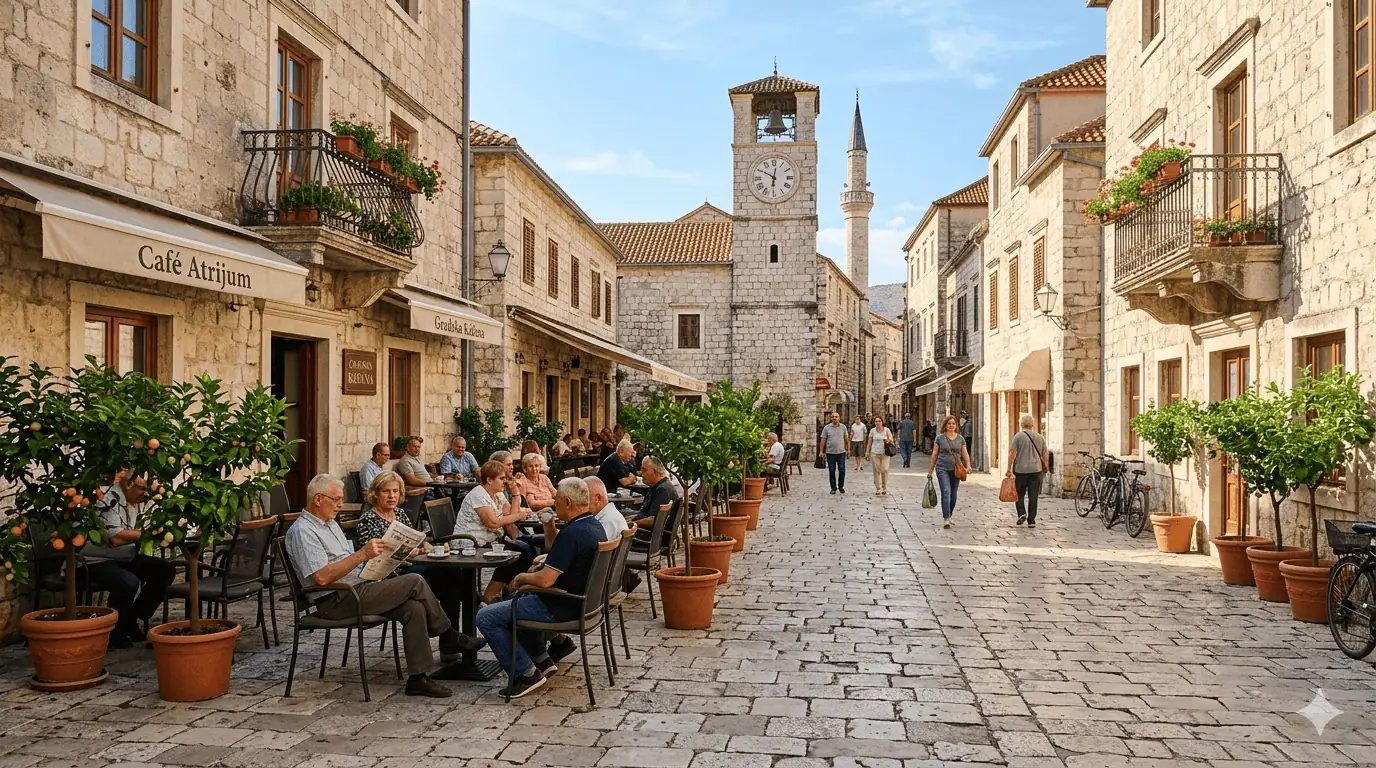
Trebinje’s famous Zelena pijaca holds the same spot it has held since the Austro-Hungarian era: Trg Slobode, Freedom Square, under the 16 plane trees planted in 1895. The history is on the town’s official tourism page for the green market, but you will feel it without reading it — this is a working farmers’ market that happens to sit in one of the prettiest squares in Bosnia and Herzegovina.
It is at its best between seven and ten, before the families with trolleys arrive and after the serious cooks have been and gone. Farmers from the mountain villages arrive before sunrise, and the first hour is theirs. What you will find:
- Figs and pomegranates in season, by weight, with a sample given freely.
- Homemade cheeses — the soft white ones that taste of the summer pasture.
- Hercegovinian prosciutto (pršut), cut to order from the leg hanging behind the stall.
- Honey, amber and dark, from the hills between here and the coast.
- Herb rakija — grape or fruit brandy steeped with sage, wormwood and whatever the garden produced.
- Produce with no label, which is the label you actually want.
The market is the natural first stop on our old town walking route, which starts in the same square — go early, shop, then walk it off among the Ottoman walls.
They taste like the sun. That’s the whole business.
The city market, indoors
A short walk from the square is the Gradska pijaca, the city market hall, which is the market’s rainy-day twin and year-round pantry. Where the green market moves with the season, the hall is static and permanent: counters of dried meats, the dairy fridge with cheeses in brine, shelves of honey and honey products, and the herbal rakija and fruit brandies that Trebinje families bottle in their backyards.
It is also the best place to shop for a bottle to carry home, because the hall’s producers are used to tourists and will wrap things properly for travel. Between the two markets you can assemble an entire Herzegovina pantry in one morning — and the where-to-eat guide tells you where to turn the haul into lunch.
The cheese
Herzegovina makes cheeses that tourists mostly never taste, because the good ones are small, few and spoken for. Look for:
- Sir iz mijeha — the famous “cheese in a sack,” aged for months inside a cured sheepskin that can hold thirty to seventy kilograms, and that shapes both the flavour and the legend. It is a Slow Food Presidium product, and it is the cheese you will be offered as a gift rather than sold.
- Hercegovačka gruda — raw cow’s-milk cheese from the villages around Trebinje, sometimes called the “queen of Herzegovina cheeses.” The version from the village of Jasen, made from family herds, is the benchmark.
- Škripavac — a young Pramenka-sheep cheese that squeaks (škripi) against the teeth when it is fresh, which is the whole point.
Much of this production is organised around the Cheese and Honey Route of East Herzegovina (Staza sira i meda), a Slow Food Trebinje project connecting sixteen family households across Trebinje, Bileća, Gacko, Nevesinje, Berkovići and Ljubinje — including two nomadic farms with their katuns still on the move. It is the closest thing the region has to a guided tour of its own kitchen; the project write-up at Snaga Lokalnog explains how it works and how to visit.
The honey
Trebinje sits on the eastern edge of the Adriatic karst, and that limestone country is sage country. The local žalfijin med — sage honey — is pale amber, slow to crystallise, and carries the herbal-savoury bite of the wild sage it is made from. It is, along with the mountain flower honey from the villages, the single most worth-carrying product in the market; the beekeeping page at Visit Trebinje gives the background on a tradition that has survived here for generations.
The beekeepers of the region have also organised — the Žalfija cooperative in Trebinje counts dozens of members across six municipalities — and their honey, eaten with the local cheese or stirred into the breakfast uštipci, is how the region pairs its two great products. It is also a recurring note on the riverside café terraces, where a pot of honey on the table is treated as normal hospitality.
The new olive oil
The most surprising thing on the market stall in the last few years has been the olive oil. Fifteen years ago Herzegovina had almost no serious olive groves; today it has hundreds of hectares and more than a hundred thousand trees, and Trebinje’s own producers are winning gold medals at the world’s top olive oil competition. The Tvrdoš monastery, already famous for its wine, took three gold awards for its extra-virgin oils, and the Podrumi Vukoje cellars added gold and silver medals of their own — roughly eight thousand olive trees now grow within the Trebinje municipality alone.
The oils are worth the price because of what the climate does to them: hot days and cold nights push the polyphenols — the antioxidants that make extra-virgin oil so good for you — well above what European standards require. The report on Tvrdoš’s gold medals at Olive Oil Times is the place to geek out over the details. A bottle of the monastery’s Chalkidiki or Kalamata oil is the most luxurious thing you will carry home from a Trebinje market, and the wineries that produce it — covered in the wine country guide — are a short drive away.
The producers beyond the square
The best of Trebinje’s food never makes it to the market. Ask at your apartment, or at the tavern, and someone will give you a phone number: the man with the olive grove, the woman who makes pogača for weddings, the family that presses oil from the local olives and only sells to people who are properly introduced.
For the rest of us, there is Hercegovačka kuća — “Herzeg House” — an organic food shop in the centre that acts as the official collection point for all of it: cheese, prosciutto, honey, wine, teas and the medicinal-herb balms that the region has been making since before pharmacies existed. It is open from seven in the morning until ten at night, and if you only have an hour, this is where to spend it. Their own site has the catalogue; the tourist organisation’s page has the location.
The rhythm of the year
- Spring: asparagus from the river meadows, early greens, the first cheese, and the sage honey crop just beginning.
- Summer: figs, peaches, tomatoes that stain your hands, wine grapes if you’re early — and the olive groves green on the hillsides.
- Autumn: pomegranates, persimmons, walnuts, the serious honey, and the olive harvest that follows the grape harvest.
- Winter: a quieter market, but the smoked meats, the hard cheeses and the aged sir iz mijeha are at their best.
The takeaway
The market is not a photo opportunity. It is the town’s working pantry, and the quickest way to understand Trebinje is to shop here — badly at first, better the second time, and then to cook something from what you carried home. Buy the sage honey. Find the sir iz mijeha. Drink the new olive oil like you are not going to be able to get it anywhere else, because you are not.