On this page
- Size, character and first impressions
- Cost of living: a real comparison
- Rent
- Groceries and eating out
- Utilities
- Overall monthly budget
- Property: buying vs. renting
- Mostar
- Trebinje
- Connectivity: getting in, getting out, and staying connected
- Airports and transport links
- Internet and mobile
- Day-to-day mobility
- Expat community and social life
- Mostar
- Trebinje
- Language
- Climate
- Healthcare
- Education and families
- Short-term rentals and investment
- Safety and quality of life
- The verdict: who should choose which
Both cities sit in Herzegovina, share a similar Mediterranean-influenced climate, and offer a quality of life that surprises most Western arrivals. Affordable living, stone architecture, good food, warm summers, and a pace that feels genuinely human — these are things both cities deliver.
But Trebinje and Mostar attract very different types of expats. The differences between them — in size, character, cost, connectivity, and daily texture — are significant enough that choosing the wrong one for your lifestyle can mean a frustrating first year. This guide looks at what actually matters for people planning to live, work, or retire here long-term, rather than those spending a long weekend.
Size, character and first impressions
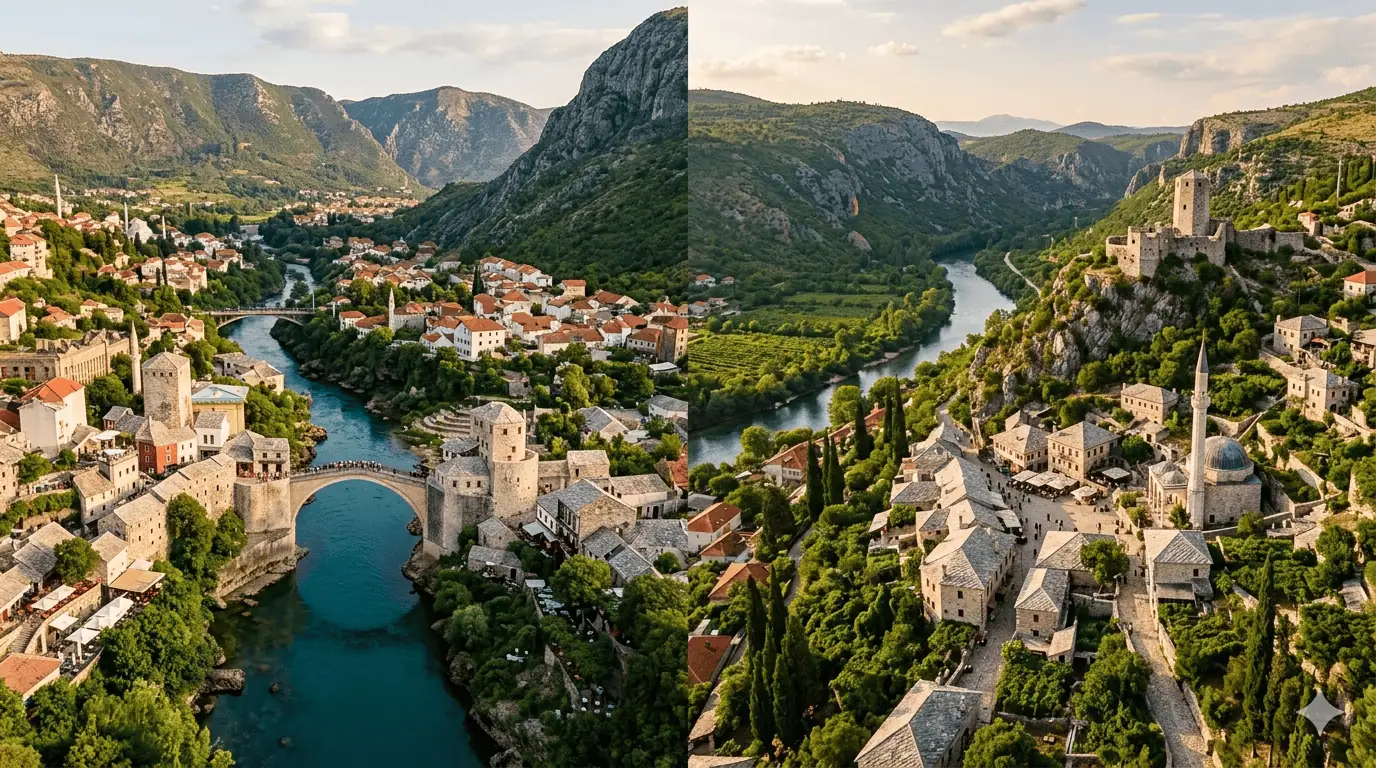
Mostar is the larger of the two, with a population of around 100,000. It’s internationally recognisable — the rebuilt Stari Most bridge is one of the most photographed structures in the Balkans — and that visibility comes with consequences. The rebuilt old town draws over a million tourists annually, and in summer the historic core becomes genuinely overcrowded, with souvenir shops, queuing tour groups, and restaurant menus priced for visitors rather than residents.
Away from the tourist core, Mostar functions as a real regional city. It has a university, a modest business district, international NGO presence, and a more established expat community than most comparable cities in the region. The tourist pressure is concentrated around the bridge and the immediate old town streets; most of the city lives normally, away from the spectacle.
That said, the spectacle affects the whole city in ways that matter to long-term residents. Short-term rental platforms have displaced housing stock. Restaurant and café pricing in desirable areas has crept upward. The character of the city centre shifts dramatically between July and October versus the rest of the year. Mostar in winter is a different place to Mostar in August — quieter, more local, and considerably cheaper.
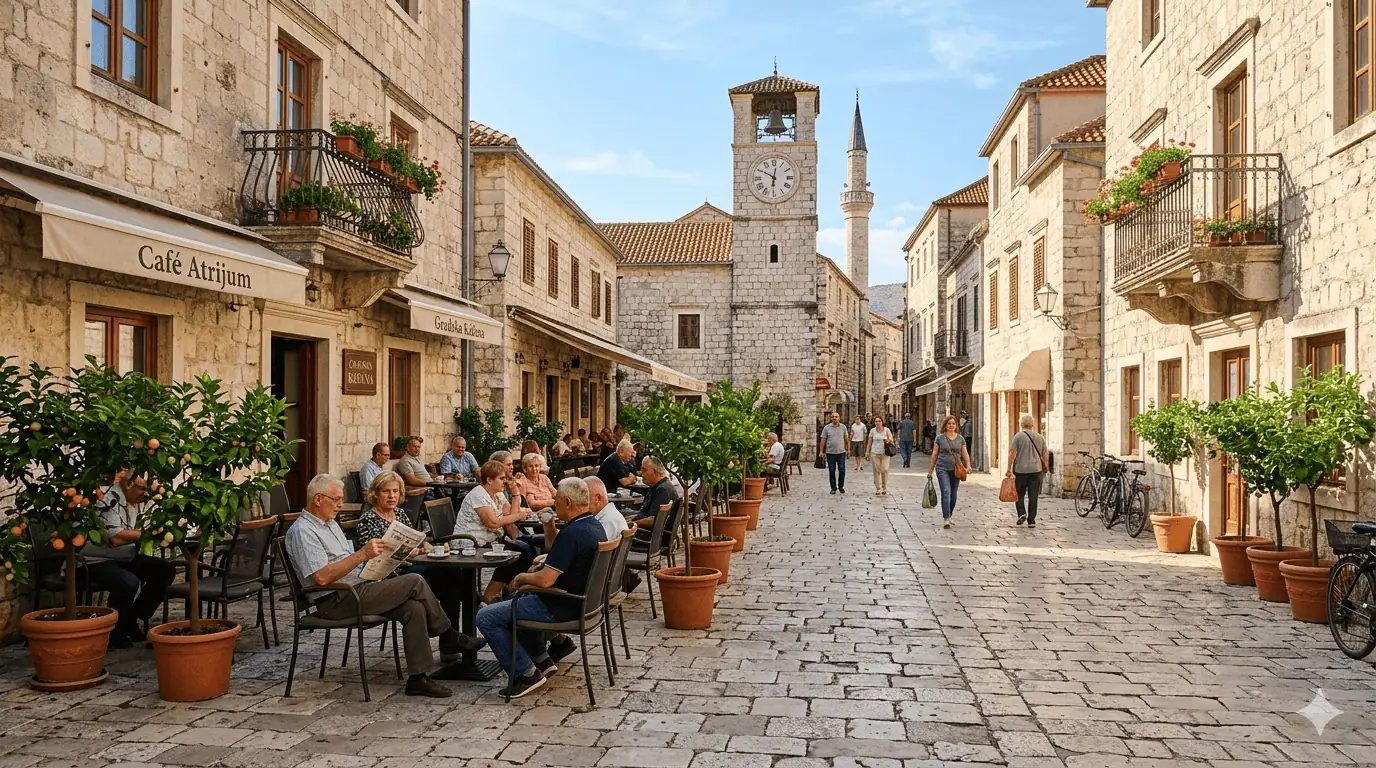
Trebinje, by contrast, has a population of around 35,000. It’s quieter, slower-paced, and largely undiscovered by mass tourism. The old town — the Stari Grad — is compact, walkable, and authentically lived-in, as our walking guide will confirm. Locals drink coffee in the same squares that tourists photograph. The city has not bifurcated into a tourist zone and a local zone; it’s simply one place, operating at one pace, year-round. The tourist organisation’s own material still sounds like it is introducing the city to people who have never heard of it, which tells you where the tourist curve actually sits.
Trebinje’s tourism is growing, particularly during summer and around the Orthodox Christmas and Easter periods. But it hasn’t yet crossed the threshold at which tourism begins to distort daily life. That makes it a fundamentally different environment to inhabit. For expats who want to live in Herzegovina rather than observe it, this distinction matters enormously.
Cost of living: a real comparison
Both cities are affordable by Western European standards, but the differences between them are meaningful when you’re living on a fixed income or remote salary.
Rent
In Mostar, a one-bedroom apartment in the city centre runs to around 749 KM per month (approximately €380), while outside the centre it drops to around 439 KM (approximately €225) — Numbeo’s Mostar figures cluster around the same numbers. In practice, desirable apartments near the old town or in popular neighbourhoods command premiums above these averages.
In Trebinje, equivalent accommodation is cheaper — typically €200–320 for a comfortable one-bedroom in or near the centre, and less still in quieter residential areas. Stone houses and larger apartments are available at prices that simply don’t exist in comparable European cities. The cost of living guide for remote workers breaks down the rent categories in detail, including the big rule: the longer you commit, the cheaper it gets.
Groceries and eating out
In Mostar, an inexpensive restaurant meal costs around 12 KM (approximately €6), a mid-range dinner for two around 50 KM (approximately €25), and a cappuccino around 2.90 KM.
In Trebinje, comparable meals run slightly higher in local restaurants — around 16 KM for a single inexpensive meal — reflecting the smaller market and fewer competing options rather than tourism pricing. Coffee remains cheap across both cities at around €1–2 for a standard espresso or cappuccino, and in Trebinje nobody hurries you out of your seat. For the full list of where the Trebinje tables actually are, the where-to-eat guide is the map.
Grocery shopping is similarly priced across both cities, with access to fresh local produce — tomatoes, peppers, courgettes, local cheese, lamb — being one of the genuine pleasures of daily life in Herzegovina regardless of which city you choose. Trebinje’s green market and its producers and stalls are a particular strength.
Utilities
In Mostar, basic utilities for a standard apartment — electricity, heating, water, and waste — run to around 208 KM per month (approximately €106). In Trebinje, expect similar figures, with electricity being the largest variable depending on whether you rely on air conditioning in summer or electric heating in winter. Stone properties retain heat and cool well, which keeps bills lower than you might expect.
Overall monthly budget
A single person living comfortably in Trebinje — eating at local restaurants several times a week, covering rent, utilities, occasional travel, and leisure — can do so for €650–900 per month depending on lifestyle. A couple can live well for €1,200–1,500. Mostar sits 10–15% higher for comparable quality of life, with the gap widening if you gravitate toward tourist-adjacent areas or international amenities.
Our detailed cost breakdowns cover Trebinje specifically: see the guide for retirees and the guide for remote workers for category-by-category figures.
Property: buying vs. renting
For expats considering a purchase rather than a long-term rental, the two cities diverge considerably.
Mostar
In Mostar, buying an apartment in the city centre costs around 371 KM per square metre (approximately €190/sqm), while outside the centre it drops to around 260 KM per square metre (approximately €133/sqm). Premium properties near the old town command significantly higher prices, and the tourism appeal of the city means values have appreciated steadily over the past decade.
This is a double-edged sword. Mostar property has performed well as an investment and offers genuine short-term rental yield potential given tourism volumes. But entry prices are higher, quality stock in desirable areas moves quickly, and the regulatory environment around short-term rentals is evolving.
Trebinje
Trebinje still offers what Mostar offered fifteen years ago: genuine value, untapped appreciation potential, and the opportunity to buy quality property without competing against investor demand. Entry-level apartments start from €50,000–70,000. Renovated stone houses in and around the old town range from €80,000–150,000 depending on condition and location. New-build apartments in good areas sit in the €80,000–120,000 range.
The investment thesis for Trebinje property is based on trajectory rather than current yield — values are rising from a low base as the city’s profile grows, and the buyers arriving now are getting in ahead of the market rather than chasing it. The digital nomad guide makes the case for the city’s direction in detail, and the wine country weekend shows what the surrounding valley has on offer for anyone weighing lifestyle alongside investment.
Connectivity: getting in, getting out, and staying connected
This is the category where Mostar has the clearest advantage for certain expat profiles.
Airports and transport links
Mostar has its own airport, with seasonal connections to several European cities. It’s small and the schedule is limited outside summer, but its existence gives Mostar residents a direct option. The city also sits on the main Sarajevo–Split road corridor and has a rail link to Sarajevo — slow and infrequent, but functional.
Trebinje has no airport and no rail connection. The nearest airport is Dubrovnik, approximately 30 minutes by car. This is actually an excellent travel hub — Dubrovnik Airport has direct connections to most major UK and European cities throughout the year, with an especially dense schedule from April through October. For expats who fly a few times a year, the Dubrovnik connection is entirely adequate. But you are car-dependent, and this needs to be factored into daily life planning. The getting around guide has the practical timetables and border-crowding wisdom.
Between the two cities, the journey takes around 90 minutes by car via the main road. There are bus connections but no direct, frequent public transport route.
Internet and mobile
In Mostar, broadband internet (60 Mbps and above) costs around 45 KM per month (approximately €23), and a mobile plan with 10GB+ data runs to around 31 KM (approximately €16).
Trebinje offers comparable connectivity at similar prices. Both cities have reliable fibre broadband in central areas and strong 4G mobile coverage. Neither will frustrate a remote worker on a normal working day. Video calls, cloud work, and multiple-device households are all well supported — Trebinje’s fibre setup is covered in the remote worker’s connectivity section.
Day-to-day mobility
Trebinje is a walkable city — the centre, old town, key cafés, the river, and most residential neighbourhoods are all within easy walking distance. A car is useful for accessing the surrounding region (the Trebišnjica river valley, the Adriatic coast, the mountains) but not essential for daily life within the city.
Mostar is larger and less walkable, though the old town area is compact. Public transport exists but is limited. Most long-term residents have a car.
Expat community and social life
Mostar
Mostar has a longer history of international presence. The post-war reconstruction period brought NGO workers, international civil servants, and diplomats in significant numbers, and some of that community remained or was replaced by subsequent waves of arrivals. The city has English-friendly bars and cafés, occasional international meetups, and enough critical mass that finding English-speaking company is not difficult.
The digital nomad and remote worker community is growing in Mostar, drawn by the city’s profile, its moderate connectivity, and the availability of co-working options. If arriving without existing connections, Mostar offers a more ready-made social entry point than Trebinje.
Trebinje
Trebinje’s expat community is smaller and newer in formation. It includes diaspora returnees from Germany, Austria, Switzerland, and the UK who have retired or semi-retired to their family’s region of origin — a path explored in the return guide; a growing number of independent remote workers attracted by the cost and quality of life; and a smaller group of property investors and lifestyle buyers.
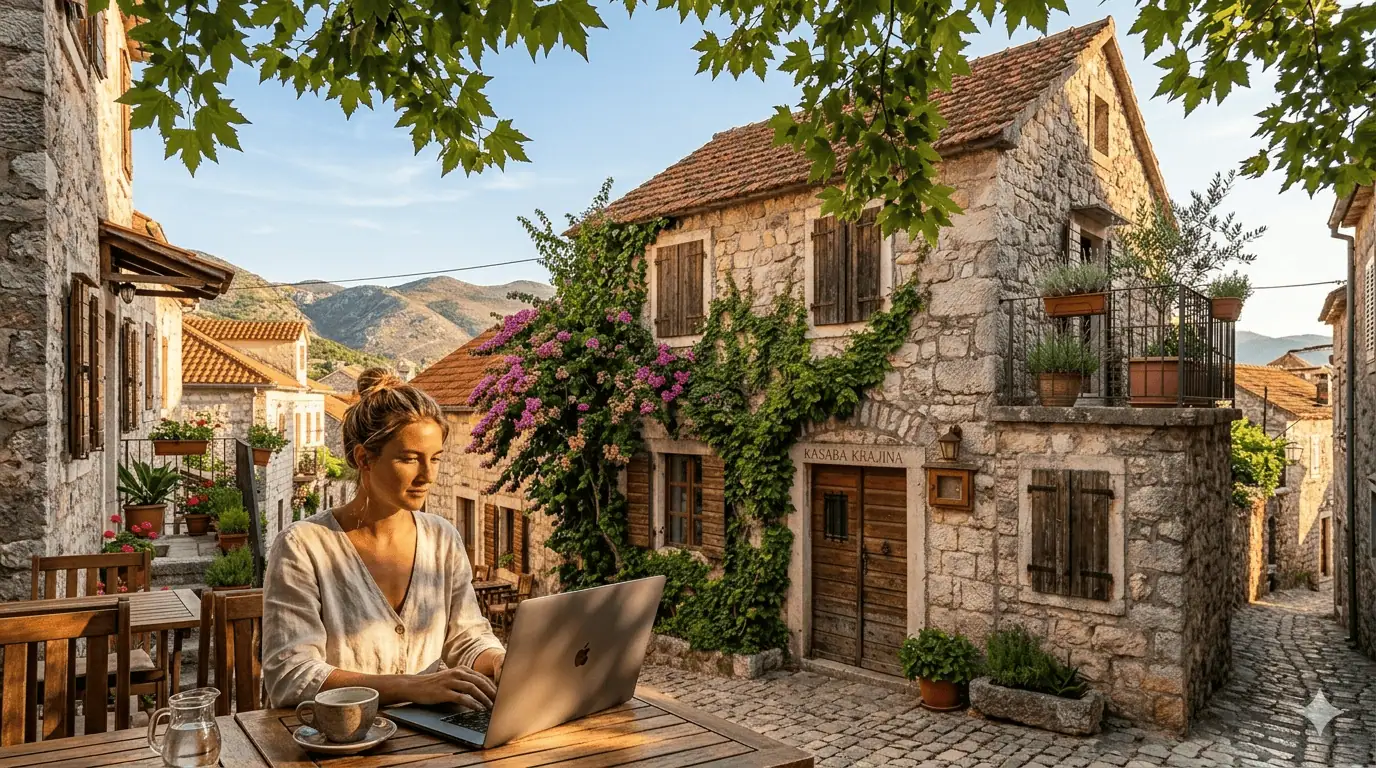
The TrebinjeLiving community has become a useful meeting point for new arrivals and those considering a move. But the community is not yet large enough to substitute for local integration. Expats in Trebinje who thrive tend to engage with the city’s social fabric — learning the language, participating in local events, forming friendships with residents — rather than relying on a parallel international social scene.
This is a meaningful difference in experience. In Mostar, you can live a largely English-language life if you choose. In Trebinje, you’ll be more comfortable — and the experience will be richer — if you make genuine efforts to engage locally. This is either an appeal or a deterrent depending on what you’re looking for. Practically speaking, the café culture is where that integration happens, and the cafés and coworking guide is the working map for it.
Language
In both cities, Bosnian/Serbian/Croatian is the daily language. English competence is growing among younger people and anyone in the tourism and service industries, but it is not reliable for all administrative, medical, or everyday interactions. Having a basic functional grasp of the local language, or access to someone who does, makes life significantly easier in either city.
Climate
Both cities share Herzegovina’s distinctive climate — hot, dry summers, mild winters, and more sunshine than almost anywhere in mainland Europe. This is one of the strongest arguments for the region overall and applies equally to both cities.
Trebinje averages around 260 sunny days per year and sits in a sheltered valley that gives it slightly warmer winter temperatures than Mostar. It is occasionally called the “city of sun” for good reason. The Bora wind that sweeps down from the mountains can be strong in winter but is short-lived.
Mostar shares broadly similar conditions, slightly cooler in winter given its higher elevation and less sheltered position. Both cities get enough rainfall in autumn and winter to keep the landscape green through spring, and both are genuinely hot from June through September — summer temperatures regularly exceeding 35°C.
For retirees, remote workers, and lifestyle-driven relocators, the climate across both cities is a genuine draw. This is not a differentiating factor between them so much as a shared regional strength.
Healthcare
Neither city offers the full spectrum of specialist medical care that a large European capital would. For anything serious, most expats travel to Sarajevo, Split, or home regardless of where they’re based in Herzegovina. That context established, there are real differences in what’s available locally.
Mostar has the larger public hospital for the Herzegovina region — a university hospital with broader specialist capacity than anything available in Trebinje. This gives it a practical advantage for residents with ongoing health needs or who want proximity to emergency care.
Trebinje has a functional local hospital and a network of GPs and specialists adequate for routine care, minor procedures, and common health issues. For anything beyond that, Dubrovnik’s private clinics — a 30-minute drive — provide good quality care at prices significantly below Western European rates. This proximity to Dubrovnik partially compensates for Trebinje’s smaller local hospital.
Private health insurance is highly recommended for expats in either city. Premiums are reasonable by Western standards, and the expat insurance guide and the remote worker’s insurance section cover the options worth considering.
Retirees in particular should factor healthcare access carefully. If you have complex or chronic conditions requiring regular specialist care, Mostar’s hospital infrastructure and better transport links make it the more practical choice.
Education and families
Most expat families with school-age children face a limited choice in Herzegovina overall. Neither city has an international school in the conventional sense. Local schools are Bosnian-language and curriculum, which poses obvious challenges for children arriving without the language.
Mostar has more educational infrastructure overall, including a university that creates a student atmosphere and some private tutoring options. For expat families determined to base themselves in Herzegovina, Mostar is the more practical choice — though many families ultimately choose Sarajevo for access to the capital’s slightly broader international school options.
Trebinje is better suited to families with younger children who haven’t yet started school, giving time to integrate and acquire language, or to couples without children. It is not an obvious choice for families with school-age children arriving without existing language skills.
Short-term rentals and investment
For expats who plan to generate income from their property — whether renting it when absent or investing specifically for yield — the two cities offer different propositions.
Mostar’s established tourism draw, international profile, and existing short-term rental market mean that a well-located property can generate meaningful income during peak season. The risk is that the market is more developed, more competitive, and increasingly regulated. Finding the right property at the right price, and managing it well in a competitive environment, requires more effort than it once did.
Trebinje’s short-term rental market is earlier stage. Peak-season occupancy for well-presented properties in the old town or near the river is solid, but the market is thinner and annual yield depends heavily on how the city’s tourism trajectory develops. The upside is that costs are lower, competition is lighter, and early-mover advantage is real.
For property investment focused primarily on long-term appreciation rather than short-term yield, Trebinje offers the more compelling case: buying into a rising market from a lower base, in a city whose profile is still developing.
Safety and quality of life
Both cities are safe by any reasonable standard. Bosnia and Herzegovina has low violent crime rates, and Herzegovina specifically is among the more peaceful and stable parts of the country. The post-war legacy is present in the architecture and the occasional visible division between communities, particularly in Mostar where the ethnic geography of the city is more pronounced. For most expats, this is a background context rather than a daily reality.
Day-to-day quality of life in both cities is high. Fresh food is excellent and affordable. The outdoor environment — rivers, mountains, the nearby Adriatic — is outstanding. Social life centres on the café culture that is central to daily life across the Balkans: coffee taken slowly, in good company, without hurry. This pace of life is one of the most frequently cited reasons expats choose Herzegovina over other low-cost relocation destinations, and the seasonal calendar shows how it plays out through the year.
The verdict: who should choose which
These are genuinely different places to live, and the choice matters more than most comparison guides admit.
Choose Trebinje if:
- You value quiet, authentic daily life over international profile and amenities
- Cost is a priority and you want maximum value on property purchase or rent
- You’re a retiree or remote worker who travels by car to Dubrovnik Airport a few times a year
- You want to integrate into local life rather than an expat bubble
- Your property strategy prioritises long-term appreciation over short-term rental yield
- You want to be an early mover in a city still finding its international audience
Choose Mostar if:
- You travel frequently and need an airport or better public transport links
- You want a larger, more established expat community from day one
- Your property strategy is focused on short-term rental yield from established tourism
- You’re relocating with school-age children and need access to more education infrastructure
- You have complex healthcare needs requiring proximity to a regional hospital
- You prefer a city with more visible international amenities, nightlife, and social infrastructure
Neither city is a wrong answer. Many expats spend time in both before deciding, which is exactly the right approach. If Trebinje is on your shortlist, the first-morning plan is a practical next step — it covers how to spend meaningful time in the city before committing, which remains the best way to know whether it fits.
Related guides: